
A bike can vanish in the time it takes to buy a coffee. In California, that window is unusually short: dense urban racks, year-round riding weather, and a resale market stretching from Bay Area flea markets to online listings all make stolen bikes easy to move. Most locks fail not because they were cheap, but because they were the wrong type for the spot. Five-digit combination locks sit in a confusing middle ground — convenient, but not equal to a hardened U-lock. Understanding what security ratings for the Ndakter lock actually measure will help you judge that trade-off honestly instead of guessing.
Quick Answer
In California, secure your bike with a hardened U-lock or heavy chain threaded through the frame and rear wheel, attached to a fixed rack that cannot be lifted or unscrewed. Add a secondary cable for the front wheel, park in visible, well-lit, high-traffic spots, and record your serial number and register the bike. Combination locks are convenient but generally offer less cut resistance than a quality U-lock, so treat them as a secondary layer rather than your only defense.
Key Takeaways
- Lock type matters more than lock price: a hardened U-lock or heavy chain resists cutting far better than any cable, regardless of how many digits the combination has.
- How you lock matters as much as what you lock with — frame plus rear wheel inside the primary lock, cable for the front wheel, and a fixed anchor that can’t be lifted over.
- California’s theft threshold means many bike thefts are treated as misdemeanors, so recovery depends heavily on your own records, registration, and a filed police report.
- Location choice is free security: a busy, well-lit rack with foot traffic beats a quiet side street with a better lock.
- Register your bike and photograph it. Without a serial number on file, a recovered bike often cannot be returned to you.
Why Bike Theft in California Is a Different Problem
California’s combination of climate, density, and enforcement realities changes the calculus for cyclists. Riding happens year-round, which means bikes are parked outside year-round, and a rack in San Francisco or Los Angeles sees far more attempted thefts than a rack in a city with a four-month riding season.
There is also a legal dimension worth knowing. Under California law, theft is generally charged as grand theft when the property value exceeds $950, and as petty theft below that line. Many bicycles fall under the threshold, and petty theft is typically handled as a misdemeanor. In practice, that means police departments prioritize bike theft lower than many riders expect, and recovery rates are modest. Some departments and campuses run bait-bike or targeted operations, but you should not build your security plan around the assumption that someone will catch the thief.
Another factor: bicycles have no license plate. A stolen bike looks like any other bike unless the serial number is checked. That is why registration and documentation — not just a good lock — are part of a complete security strategy in California, Once you have mastered proper locking techniques for urban parking, you might also want to learn how to use a cruiser bike for commuting to make your daily rides more comfortable.
Which Lock Type Actually Stops a Thief
Most bike thefts in California cities are crimes of opportunity carried out with hand tools: cable cutters, bolt cutters, a cordless angle grinder, or simply lifting a poorly locked bike off a rack. Matching the lock to the realistic threat is the whole game.
| Lock type | Cut resistance | Portability | Best use | Main weakness |
|---|---|---|---|---|
| Hardened U-lock (D-lock) | High — needs heavy tools or a grinder | Moderate; needs a frame mount | Primary lock in cities and on campuses | Limited reach; bulky to carry |
| Heavy chain lock | High — square-link chains resist cutters well | Low; heavy and awkward | Leaving at a regular parking spot | Weight; cheap chains fail badly |
| Folding lock | Moderate to high | Good; folds small | Riders who want more reach than a U-lock | Riveted joints can be attacked |
| Cable lock | Low — cut in seconds with hand tools | High | Secondary lock for wheels or a saddle | Should never be your only lock |
| Combination cable or chain lock | Varies; the mechanism adds a picking risk on top of cut risk | High | Short stops, low-risk areas, secondary use | Convenience often outweighs the protection |
Where combination locks fit
A five-digit combination lock such as the Ndakter model offers a real practical advantage: no key to lose, and 100,000 possible codes, which makes casual code-guessing impractical. That is a meaningful improvement over four-digit locks, where the search space is ten times smaller.
What a combination does not change is the material the lock is made of. If the shackle or cable can be cut, the number of digits is irrelevant. So the honest way to read a rating on a combination lock is to ask what it was tested against: cutting, picking, corrosion, or all three. A rating that reflects pick resistance tells you nothing about how the lock performs against bolt cutters, and vice versa.
The rating systems worth knowing
The United States does not have a single mandatory consumer rating standard for bike locks. The most widely cited benchmark internationally is Sold Secure, which grades locks as Bronze, Silver, Gold, or Diamond based on how long they resist simulated attacks with real tools. Diamond-rated locks are expected to survive extended grinder and cutting attacks; Bronze-rated locks are intended for low-risk, short-duration use.
When you see a rating on any lock, check three things: who issued it, what tools were used in the test, and whether the rating is for the whole lock or just part of it. A chain rated Gold paired with a cheap padlock is only as strong as the padlock.
The Locking Method Matters More Than the Lock
A high-quality lock used badly is weaker than a mid-range lock used well. The difference usually comes down to two questions: what is inside the lock, and what is the lock attached to.
Lock the frame, not just the wheel
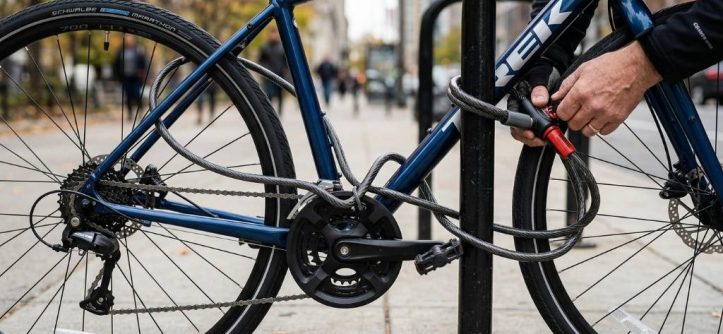
The most common mistake is threading a lock through the front wheel and calling it done. A thief can unbolt the wheel, leave it, and walk off with the rest of the bike. The standard method is to pass the primary lock through the rear wheel, the frame’s rear triangle, and the fixed rack all at once. That secures the two most valuable components with one lock.
If you have quick-release wheels, add a secondary cable threaded through the front wheel and looped onto the primary lock. It will not stop a determined thief, but it removes the easy target. The same applies to a quick-release saddle, which is one of the fastest things to steal and one of the cheapest to protect with a short cable or a locking seat clamp.
Choose an anchor that cannot be defeated
The rack matters. Avoid anything a thief can lift the bike over: a short post, a rack with an open top, or a pole where the bike can be raised and slipped free. Avoid signposts that can be unscrewed and parking meters, which are frequently targeted. Trees are a poor choice because they can be cut and because locking to them damages the bark.
Fill the lock as much as possible. A U-lock with a large empty gap gives a thief room to insert a jack or a pry bar. Choose the smallest lock that comfortably fits around your frame and the anchor.
Where to Park in California Cities
Parking location is the cheapest security upgrade available, and it costs nothing. Prioritize racks that are visible from a window, covered by a camera, and near foot traffic. Thieves prefer racks that are hidden from view and where a person working on a lock for two minutes would not look out of place.
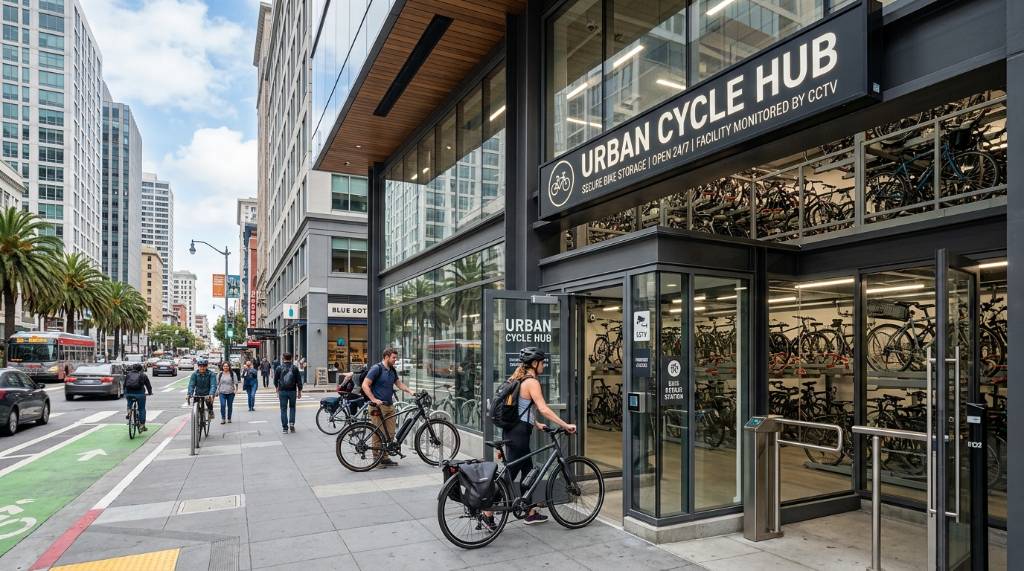
For transit riders, some California agencies and campuses offer enclosed bike parking, lockers, or attended facilities at major stations. These are usually worth the small fee or deposit compared with leaving a bike locked on the street all day, and often dramatically better than overnight street parking.
Overnight parking is where the risk curve jumps sharply. If you must leave a bike outside overnight, use a heavy chain or U-lock plus a cable, remove anything detachable, and choose a location with lighting and foot traffic. Where possible, bring the bike inside — a hallway, an apartment, or an office — because no lock outperforms a locked door.
A Practical Locking Routine
- Pick the rack first. Look for a fixed, thick, closed-loop anchor in a visible, well-lit spot.
- Remove lights, bags, pumps, and anything with a quick release.
- Thread the primary lock through the rear wheel, the frame triangle, and the rack.
- Close the lock and check that the gap is as small as possible.
- Run the secondary cable through the front wheel and, if needed, the saddle rails, then loop it onto the primary lock.
- Tug the bike gently. If anything moves independently of the anchor, you have missed a component.
- Photograph the locked bike if you are leaving it for hours. It documents your setup and the location.
Common Mistakes California Riders Make
- Using a cable as the only lock. Cable cutters are small, cheap, and quiet. A cable is a supplement, not a primary lock.
- Locking to the wheel only. The wheel is replaceable; the frame and drivetrain are not.
- Assuming a busy street is safe at night. Foot traffic drops after dark, and so does the deterrent effect.
- Never recording the serial number. Without it, a recovered bike usually cannot be matched to you.
- Leaving the bike in the same spot every day. Predictable patterns make planning easy for a thief.
- Trusting a lock rating without checking what it covers. Ratings apply to specific tests, not to every threat.
What to Do If Your Bike Is Stolen in California
File a police report promptly, even if you expect little follow-up. The report is often required for insurance claims, and it is what links a recovered bike back to you if it turns up in a pawn shop or a police recovery lot. Have your serial number ready — this is where registration pays off.
Then report the theft to a stolen-bike registry and post clear photos with the serial number. In California, stolen bikes frequently surface at flea markets, swap meets, and online marketplaces, so checking those channels in the days after the theft is worthwhile. If you spot your bike for sale, contact police rather than confronting the seller.
Finally, check your renters or homeowners insurance. Coverage for bicycles varies by policy, and the deductible may exceed the value of a lower-priced bike, so it is worth confirming before you need it.
Frequently Asked Questions
Is a five-digit combination lock strong enough for a bike in California?
It depends on the material, not the digits. A five-digit code makes guessing impractical, but a combination lock with a thin cable or soft shackle can still be cut in seconds. Use one as a secondary lock or for short, low-risk stops, and pair it with a hardened U-lock or chain for anything longer.
What is the most secure way to lock a bike to a rack?
Pass a hardened U-lock or heavy chain through the rear wheel, the frame triangle, and the rack together, then use a cable for the front wheel. Keep the lock body tight against the frame so there is no room for a jack or pry bar.
Do I need to register my bike in California?
California does not require statewide bicycle registration, but many cities, universities, and transit systems run their own programs. Registration is less about legal compliance and more about recovery: a recorded serial number is usually what allows a recovered bike to be returned.
Are U-locks better than chain locks?
Both can be highly secure. U-locks are easier to carry and offer a tighter fit, which limits leverage attacks. Heavy chains give more reach and can wrap around awkward anchors. The weak point in either case is usually a cheap lock mechanism or a chain with soft links.
Where should I park my bike overnight in a California city?
Indoors whenever possible. If that is not an option, use an enclosed or attended bike facility, or a well-lit rack with foot traffic and camera coverage. Overnight street parking is the highest-risk scenario and warrants your strongest lock plus a cable.
What should I do first if my bike is stolen?
File a police report with your serial number, then list the bike on a stolen-bike registry with photos and details. Check local flea markets and online marketplaces in the following days, and contact your insurer about coverage.
Conclusion
Securing a bike in California comes down to three things working together: the right lock type, the right locking technique, and the right parking spot. A hardened U-lock or heavy chain through the frame and rear wheel, a cable for the front wheel, and a visible, well-lit anchor will defeat the vast majority of opportunistic thefts. Combination locks are convenient and worth carrying, but they belong in a supporting role. Register the bike, photograph it, and know your serial number — that is what turns a theft into a recoverable loss instead of a permanent one.



Leave a Reply