
Choosing the right mountain bike frame size can feel overwhelming. There are so many numbers, charts, and terms to decode. However, getting this decision right makes a huge difference. The correct frame size gives you better control on the trail, reduces fatigue, and helps you ride longer without discomfort. This guide breaks it all down in a simple, practical way.
Why Frame Size Matters More Than You Think
Many riders focus on components like gears, brakes, or tires when buying a bike. Those things matter, but frame size matters more. A poorly sized frame forces your body into awkward positions. Over time, that leads to pain in your knees, back, and wrists.
A well-fitted frame, on the other hand, puts your body in a natural riding position. You feel in control. You can steer smoothly, absorb bumps easily, and power through climbs without strain. Therefore, sizing should always be your starting point before anything else.
Start With Your Height and Inseam
The two most important measurements you need are your height and your inseam length. Your height gives a general starting point. Your inseam helps fine-tune the fit, especially for standover height, which is the clearance between you and the top tube when you stand flat-footed over the bike.
To measure your inseam, stand barefoot with your back against a wall. Place a book between your legs as if it were a bike saddle. Measure from the floor to the top of the book. Write that number down. You will use it throughout the sizing process.
Additionally, your arm length and torso length play a role in how a frame feels. Two riders with the same height can have very different proportions. That is why general sizing is just a starting point, not a final answer.
How to Read an MTB Sizing Chart
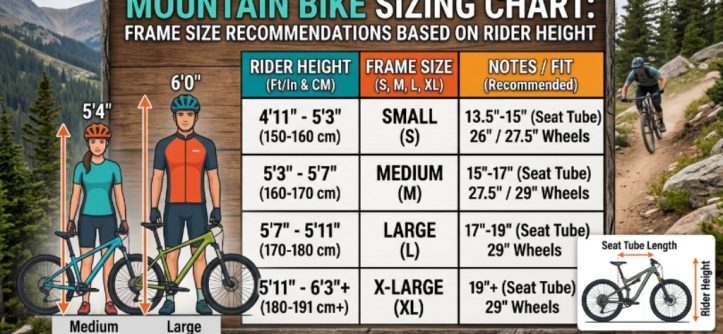
An MTB sizing chart maps your height to a recommended frame size. Frame sizes are listed in small (S), medium (M), large (L), and extra-large (XL), or sometimes in centimeters. Most brands publish their own charts, and the ranges can vary slightly between manufacturers.
Here is a general guide based on rider height bike size pairings that most brands follow:
- Under 5’4″ (163 cm) — Small frame
- 5’4″ to 5’7″ (163–170 cm) — Small to Medium frame
- 5’7″ to 5’11” (170–180 cm) — Medium to Large frame
- 5’11” to 6’2″ (180–188 cm) — Large frame
- Over 6’2″ (188 cm) — Extra-Large frame
However, these ranges overlap for a reason. If you fall between two sizes, your riding style helps decide. Riders who prefer aggressive trail riding often go smaller for quicker handling. Riders who prioritize comfort and long-distance riding often go larger for a more stable feel.
Understanding Frame Geometry Basics
Numbers on a spec sheet only tell part of the story. Frame geometry basics explain how a bike actually handles on the trail. Even two frames of the same size can feel completely different depending on their geometry.
Here are the key geometry terms you should know:
Reach is the horizontal distance from the bottom bracket to the top of the head tube. A longer reach stretches you out more. It suits aggressive riders who like to lean forward. A shorter reach keeps you upright, which is better for casual or trail riding.
Stack is the vertical height from the bottom bracket to the top of the head tube. A higher stack raises your handlebar position, making the ride more comfortable and upright.
Head tube angle affects how the fork sits relative to the ground. A slacker angle, around 64 to 66 degrees, improves high-speed stability on steep descents. A steeper angle, around 68 to 70 degrees, gives snappier steering for cross-country trails.
Chainstay length is the distance from the rear axle to the bottom bracket. Shorter chainstays make the bike feel agile and easy to lift the front wheel. Longer chainstays improve stability and traction on climbs.
Seat tube angle determines how your hips sit over the pedals. Modern bikes use steeper seat tube angles, often between 74 and 78 degrees, to keep the rider centered for better pedaling efficiency.
Understanding these numbers helps you compare bikes beyond just the listed size. Two bikes in a large frame can feel very different because of these geometry choices.

Fitting Yourself on the Bike
Reading charts and geometry numbers is helpful. However, nothing replaces actually sitting on the bike. If you can, visit a local bike shop and test ride a few options.
When you sit on the saddle with your foot at the bottom of the pedal stroke, your knee should have a slight bend, not fully extended. Your back should angle forward naturally without hunching. Your arms should reach the handlebars with a slight bend at the elbows, not locked out straight.
Additionally, check the standover height. When you stop and stand flat-footed over the frame, there should be at least one to two inches of clearance between you and the top tube. Mountain bikes often have sloping top tubes, so this clearance is usually easy to achieve, but it is still worth checking.
If everything feels right and you are not stretching or cramping, the size is likely a good match.
Adjustments That Can Fine-Tune the Fit
Even after picking the right frame size, small adjustments can improve your comfort. These changes do not replace proper sizing, but they help dial in the final feel.
Saddle height is the most important adjustment. Raising or lowering the seat affects your power output and knee comfort significantly. Saddle fore-aft position moves you closer to or farther from the handlebars. Stem length and handlebar width also affect your reach and control.
Therefore, think of frame size as the foundation and these adjustments as the finishing touches. Getting both right gives you the most comfortable and controlled ride possible.
Common Sizing Mistakes to Avoid
Many riders make avoidable mistakes when sizing a bike. One of the most common is buying based on looks or price rather than fit. A bike that looks great but fits poorly will become frustrating quickly.
Another mistake is ignoring the rider height bike size chart entirely and relying only on what a salesperson says. Charts are not perfect, but they give you an important baseline. Use them, then verify with a test ride.
Some riders also size up thinking a bigger bike will feel more stable. However, a frame that is too large reduces your ability to maneuver. It puts you in a stretched position that causes shoulder and lower back pain on longer rides.
Conclusion
Picking the right mountain bike frame size comes down to a few key steps. Start by measuring your height and inseam. Use an MTB sizing chart to find your starting range. Then study the frame geometry basics to understand how the bike will actually handle. Sit on the bike to confirm the fit feels natural. Finally, make small adjustments to the saddle and handlebars to fine-tune your position.
Getting the size right is the single best thing you can do for your comfort and trail performance. It sets the foundation for every ride that follows.
Frequently Asked Questions
What size mountain bike frame do I need for my height?
Use a standard MTB sizing chart as a starting point. Riders under 5’4″ usually need a small frame. Riders between 5’7″ and 5’11” typically fit a medium or large. Always verify with a test ride since brands differ slightly.
Is it better to size up or size down in mountain bike frames?
It depends on your riding style. Aggressive riders often size down for quicker handling. Riders who value comfort and stability may size up. However, avoid going more than one size away from your recommended range.
Can I adjust a bike that is slightly too big or too small?
Minor sizing differences can be corrected with stem length, saddle position, and handlebar adjustments. However, these fixes have limits. A frame that is significantly too large or too small will never feel fully comfortable, regardless of adjustments.
What is standover height, and why does it matter?
Standover height is the clearance between you and the top tube when you stand flat-footed over the bike. You need at least one to two inches of clearance for safe dismounts, especially on rough trails where you may need to stop suddenly.
Do women need a different mountain bike frame size than men?
Women’s-specific bikes often have a shorter reach and adjusted geometry to suit typically shorter torso lengths. However, the best approach is always to use your own measurements and test the bike in person, regardless of how it is marketed.
Related Topics:
How to Properly Adjust a Bike Helmet for Maximum Safety
Shredded Memory Foam Pillow Guide: Coop vs Others




Leave a Reply